
What to Do after a Bad Food Day (Without Starting Again Monday)
You know that tiny, horrible moment after the food bit has already happened?
Not before, when everyone online is very helpfully telling you to “plan ahead” as though your life is run by a calm woman with a label maker.
After.
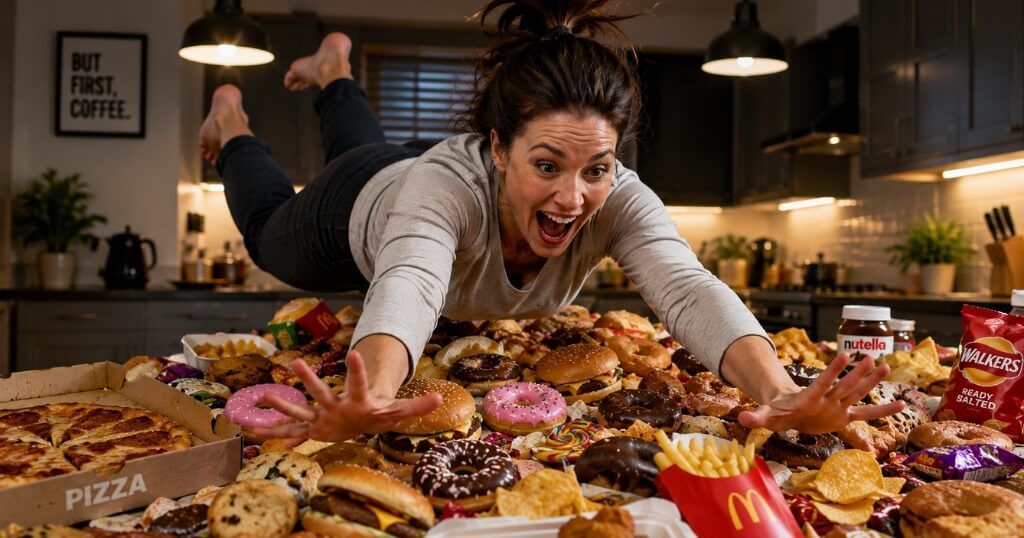
After the takeaway bag is folded on the side. After the wine glass is in the sink. After the chocolate wrapper has somehow migrated under a cushion like it’s trying to flee the scene. After you’ve eaten the children’s crusts, a handful of crisps, three fridge investigations and something you don’t even remember choosing.
The house is finally quiet.
You’re tired.
FREE AUDIOBOOK + PDF
GET THE BOOK.
KEEP THE SUPPORT.
Get the complete The Busy Girl’s HOT Body Plan audiobook and PDF free — plus my regular emails with practical fitness, food and mindset help for fitting this stuff around an actual life.
No wellness waffle. No diet nonsense. Unsubscribe whenever you like.

Your bra may already be off, which means the day has formally entered its final legal phase.
And then your brain starts.
“Well, that’s ruined.”
Not “that was more than I planned.”
Not “I was stressed and tired.”
Not “tomorrow can still be normal.”
Ruined.
One word, dramatic little cape, enormous consequences.
Because once your brain has decided the day is ruined, it starts issuing instructions like an unqualified dictator in pyjamas.
Finish the biscuits.
Have the toast.
Start again Monday.
Might as well make the damage worth it.
Which is a deeply strange idea when you think about it.
If you dropped your phone and cracked the screen, you wouldn’t say, “Ah well, better throw it into the road and reverse over it twice so I can really commit to the theme.”
But with food, that’s often exactly what happens.
The problem usually isn’t the takeaway, the wine, the chocolate, the missed workout or the chaotic patch.
The problem is the story that arrives afterwards.
And if your plan has no instructions for that moment, real life will keep beating it with a school shoe.
Why “starting again Monday” feels tempting
“Start again Monday” feels clean.
It sounds organised. Fresh. Sensible. Like the future version of you is about to appear wearing matching activewear, holding a meal plan and speaking in calm bullet points.

That’s why it’s so seductive.
Monday promises a blank page.
But most people don’t need more blank pages. They’ve got enough of those. Half-used notebooks. Fitness apps downloaded with great ceremony. Food plans abandoned by Wednesday afternoon. A water bottle that was meant to change everything but now lives in the car footwell with two receipts and a raisin of unknown age.
What they need is a return route.
Because the all-or-nothing loop is not complicated.
Something doesn’t go to plan.
You decide it means something about you.
That feeling turns into “sod it.”
“Sod it” turns one meal into an evening, an evening into a weekend, and a weekend into Monday morning’s grand reopening of the self-improvement circus.
Then Monday becomes too strict, because it has to compensate for everything that happened before it.
So you try to be perfect.
Then real life leans on the doorbell again.
And off you go.
That isn’t a willpower problem. It’s a design problem.
Any plan that only works while you’re well-rested, emotionally balanced, fully stocked with vegetables and surrounded by people who make no demands is not a plan.
It’s fantasy fitness with a ring light.
A proper plan needs a boringly useful instruction for this exact moment:
“What do I do after it didn’t go to plan?”
Not after the ideal day.
After the messy one.
After the “I ate it standing up” one.
After the “I appear to have had dinner in instalments between 6pm and 10pm” one.
That’s where the result is built.
Not in the perfect day.
In the comeback.
The 10-minute reset: close the file
The first job after a bad food day is not to fix your whole life.
It’s to close the file.
That’s it.
Because your brain will try to keep the case open. It’ll keep presenting evidence. It’ll call expert witnesses from previous failed diets. It’ll bring up the jeans, the holiday, the Christmas party, the photos, that one comment someone made in 2018 and the fact you once bought chia seeds with serious intentions.
No thank you.
Court is adjourned.
Here’s the reset.
1. Name it accurately
Don’t say, “I’ve ruined it.”
Say what actually happened.
“I ate more than I planned.”
“I had a stressful day and used food to switch off.”
“I missed my workout.”
“I had drinks and snacks and now I’m tired.”
“I’ve had a messy weekend.”
That language matters.
“I’ve ruined it” is a trapdoor.
“I ate more than I planned” is information.
One sends you into the snack cupboard wearing a miner’s helmet. The other lets you make a decision.
2. Stop the sequel
A lot of damage is done in the sequel.
The original event might be fairly normal: takeaway, birthday meal, wine, chocolate, missed workout, weekend away.
The sequel is where your brain says, “Well, since we’re here…”
That’s when one choice becomes a kitchen-based incident involving toast, cereal, crisps, cheese, biscuits and a spoonful of peanut butter eaten with the energy of someone defusing a bomb.
Pause there.
You don’t have to make the evening worse to prove the evening wasn’t perfect.
Put the food away. Brush your teeth. Make tea. Go upstairs. Sit somewhere that isn’t within arm’s reach of the cupboard that knows too much.
Not because you’re being strict.
Because you’re refusing to let one choice become a documentary.
3. Drink some water and go low-drama
Water won’t erase a takeaway. It won’t perform witchcraft. It won’t make your body forget that garlic bread entered the building.
But it can help you stop mistaking thirst, salt, tiredness and a fuzzy head for a fresh snack emergency.
Drink some water.

Then lower the drama.
No meal-plan funeral.
No standing in the kitchen declaring tomorrow will be different while holding a biscuit like evidence.
No ceremonial binning of every food you enjoy, especially when everyone knows you’ll buy it again three days later while furious, hungry and weirdly committed to the bit.
4. Decide the next normal thing
This is the whole game.
Not the next perfect thing.
The next normal thing.
That might be sleep.
It might be breakfast tomorrow.
It might be lunch if breakfast is already gone.
It might be your next planned workout.
It might be a ten-minute walk to clear your head and remind your body that it is not, despite recent events, a skip with eyebrows.
A reset doesn’t need Monday.
It doesn’t need a new month.
It doesn’t need a motivational quote graphic.
It needs the next sane, useful action.
What not to do, even though your brain will suggest it
After a bad food day, your brain often tries to become a diet coach from 2006.
Ignore it.
It has terrible ideas and probably wore low-rise jeans the first time round.
Don’t skip breakfast to make up for it
This feels like balance.
It often becomes a trap.
You skip breakfast because you’re “being good”. Then lunch is tiny because the punishment tour is still in progress. By late afternoon, your body has had enough of this nonsense and starts sending urgent messages like a toddler in a lift pressing every button.
Then the evening arrives.
And suddenly you’re back in the kitchen, eating with the calm focus of a woman who has stopped negotiating.
Eat normally.
Get something filling into the next meal. Protein helps. Fibre helps. Food that looks like an actual meal helps.
You’re not trying to pay a debt.
You’re trying to stop creating another one.
Don’t turn exercise into a punishment
A walk can be brilliant.
A short workout can be brilliant.
Movement can help your mood, energy, digestion, confidence and sense of control.

But if the thought is, “I need to burn off last night,” pause.
That’s not training.
That’s a food apology with squats in it.
Exercise is there to build you up, not to act like a parking fine for pudding.
Do something because it helps you feel better.
Not because dinner needs a receipt.
Don’t weigh yourself six times
Especially after salty food, alcohol, late nights or a bigger meal.
The scale may jump. That does not mean you’ve gained dramatic fat overnight. It may mean there’s more food sitting in your system, more water being held, or your body is simply doing normal body things while you interrogate it under bathroom lighting.
The scale is a tool.
After a takeaway and poor sleep, it often becomes a tiny plastic gossip with numbers.
Don’t give it the morning meeting.
Don’t declare the week ruined
This is one of the sneakiest bits of all-or-nothing thinking.
One missed workout becomes “I’ve lost the week.”
One birthday meal becomes “I may as well carry on.”
One takeaway becomes “What’s the point now?”
The point is that you’re still here.
The week is still happening.
You don’t have to set fire to the calendar because Thursday got ideas above its station.
Don’t wait for Monday
Monday is not magic.
It’s just a day that arrives with emails.
If you wait for Monday every time something goes wrong, you train yourself to need a fresh start before you’re allowed to look after yourself.
You don’t.
You can come back halfway through a day.
Halfway through a meal.
Halfway through an evening.
Halfway through the thought, “Sod it, I’ve blown it.”
That moment is not failure.
That moment is the door.
Real-life examples: the old spiral vs the comeback
Here’s how this looks in actual life, where nobody has unlimited time, perfect sleep or a fridge full of colour-coded containers behaving like a lifestyle advert.
Friday takeaway
The old spiral:
Takeaway becomes proof the weekend is gone, so Friday night turns into Saturday snacks, Sunday grazing and a Monday morning plan so strict it could supervise a prison wing.
The comeback:
Eat it from a plate. Enjoy it properly. Put the leftovers away. Drink some water. Next meal is normal. No speech required.
Wine and snacks after a stressful day
The old spiral:
One hard day becomes three nights of “I deserve this”, even though by night three it no longer feels like a treat and mostly feels like being trapped in a crisp-based admin system.
The comeback:
Notice the moment you’ve had enough. Stop there if you can. Get to bed. Tomorrow is not a compensation project. It’s just tomorrow.
Missed workout because work ran late or someone needed you
The old spiral:
You miss one session and decide the entire week’s training has collapsed like a camping chair at a family barbecue.
The comeback:
Do five or ten minutes if it genuinely helps. If not, do the next planned session. Consistency includes picking things back up.
Birthday meal or family do
The old spiral:
Cake becomes evidence. The buffet becomes a personality test. You leave feeling as though a sausage roll has issued a formal statement about your future.
The comeback:
Enjoy the occasion. Eat like you’re allowed to be there. Then return to normal at the next meal without turning it into a courtroom drama.
Weekend away
The old spiral:
You come home and launch Operation Punishment: no carbs, too much exercise, a fridge full of leaves, and the emotional warmth of a tax letter.
The comeback:
Unpack. Hydrate. Get a few useful meals in the house. Take a short walk if it helps. Restart the routine gently enough that you’ll actually do it.
The goal isn’t to never go off plan
You are not trying to become a woman who never has a takeaway, never drinks wine, never eats chocolate, never misses a workout, never has a stressful night, never goes away for the weekend and never finds herself eating toast at an hour when toast has become less of a food and more of a coping mechanism.
That woman doesn’t exist.
And if she does, she probably has staff.
The goal is not perfect compliance.
The goal is self-trust.
You want to become the woman who can have a messy evening and not disappear for five days.
The woman who can miss a workout and still do the next one.
The woman who can eat birthday cake without treating it like a resignation letter.
The woman who can say, “That wasn’t ideal,” without adding, “so I may as well abandon myself until Monday.”
Because that’s the real win.
Not never wobbling.
Not never overeating.
Not never getting tired, stressed, busy, hormonal, distracted, social, fed up or ambushed by a packet of chocolate buttons you bought “for the kids” and then investigated personally.
The win is knowing how to come back.
You don’t need to prove you can be perfect.
You need to prove to yourself that you can recover without drama.
That is a skill.
And like most useful skills, it’s built in the unglamorous moments nobody puts on Instagram.
The glass of water.
The normal breakfast.
The walk round the block.
The workout you do even though it’s shorter than planned.
The decision to close the cupboard.
The choice to stop calling yourself names and just carry on.
We don’t diet.
We come back.
What to do now
If yesterday went sideways, you don’t need a new identity.
You don’t need a punishment plan.
You don’t need to wake up Monday as a completely different woman with matching activewear, pre-chopped vegetables and a facial expression that suggests she’s never argued with a fitted sheet.
You need one helpful step.
That might be your next meal.
It might be water.
It might be sleep.
It might be a walk.
It might be pressing play on a short home workout and doing what you can.
The point is not to make the past disappear.
The point is to stop giving it the steering wheel.
KS14 gives you 14 days of short home workouts, simple food support and a plan designed for real life — including the days that don’t go neatly to plan.
No starting again Monday.
Start from the next useful choice.